
The word taxidermy comes from two Greek roots meaning the arrangement of skin, which is a modest description for a craft that has moved from the apothecary’s shelf to the parlour, to the museum hall, and now to the artist’s studio. Its history is a history of people trying to hold on to animals they admired, and of the slow discovery of how to do it without the animal falling apart. We think it is worth knowing, because every mount on a wall today carries a few centuries of trial and error inside it.
Before there was a method
People have preserved animal remains for as long as they have hunted. Ancient Egyptians embalmed cats, ibises and crocodiles by the million, though as offerings rather than as displays. Medieval and Renaissance cabinets of curiosities held dried crocodiles and pufferfish hung from the ceiling, along with skins stuffed with straw and rags. The results were crude, and they rarely lasted, because nobody understood that the skin itself had to be treated or insects would eat it within a few seasons.
The turning point came in the eighteenth century, when European naturalists began to receive specimens from voyages to Africa, Asia and the Americas and needed them to survive long enough to be studied. Around 1740 a French pharmacist published a preservation method using arsenical soap, a paste of arsenic, camphor and soap rubbed into the inside of the skin. It was poisonous to the preparator as well as to the moths, but it worked, and it stayed in use in museums for nearly two hundred years. Many antique mounts still contain arsenic today, which is a reason to handle them with gloves.
The Victorian craze
By the middle of the nineteenth century, taxidermy had become a respectable trade and a middle-class enthusiasm. The Great Exhibition of 1851 in London gave it a stage. Glass cases of birds became fixtures of the Victorian drawing room, and stuffed songbirds, owls and hummingbirds were sold by the thousands. Naturalists filled their studies with specimens; hunters brought back heads from Africa and India; and every town of any size had a taxidermist’s shop.
The period also produced the anthropomorphic scene, in which kittens attended weddings, squirrels played cards and frogs fenced with tiny swords. These tableaux were enormously popular and look faintly disturbing today, but they show something important about the era’s mounts: the skin was still being stuffed, quite literally, with tow, straw and cotton wound around a wire armature. The animal took the shape of whatever the taxidermist packed inside it, and the results, especially for large mammals, were often lumpy and wrong. Museum lions of the time have a slightly startled, overfed look that comes from this method.
Carl Akeley and the invention of the modern mount
The person who changed all of this was Carl Akeley, an American born in 1864, who began as an apprentice at a commercial natural history supply house and ended as the most celebrated taxidermist who ever lived. Akeley’s insight was that the animal should be sculpted first and skinned second. Instead of stuffing a hide, he built an accurate clay model of the animal’s body over its own skeleton, studying muscle and tendon as a sculptor would, then cast the model in plaster and built a light hollow form from it. The tanned skin was then fitted over a form that already looked like the living animal.
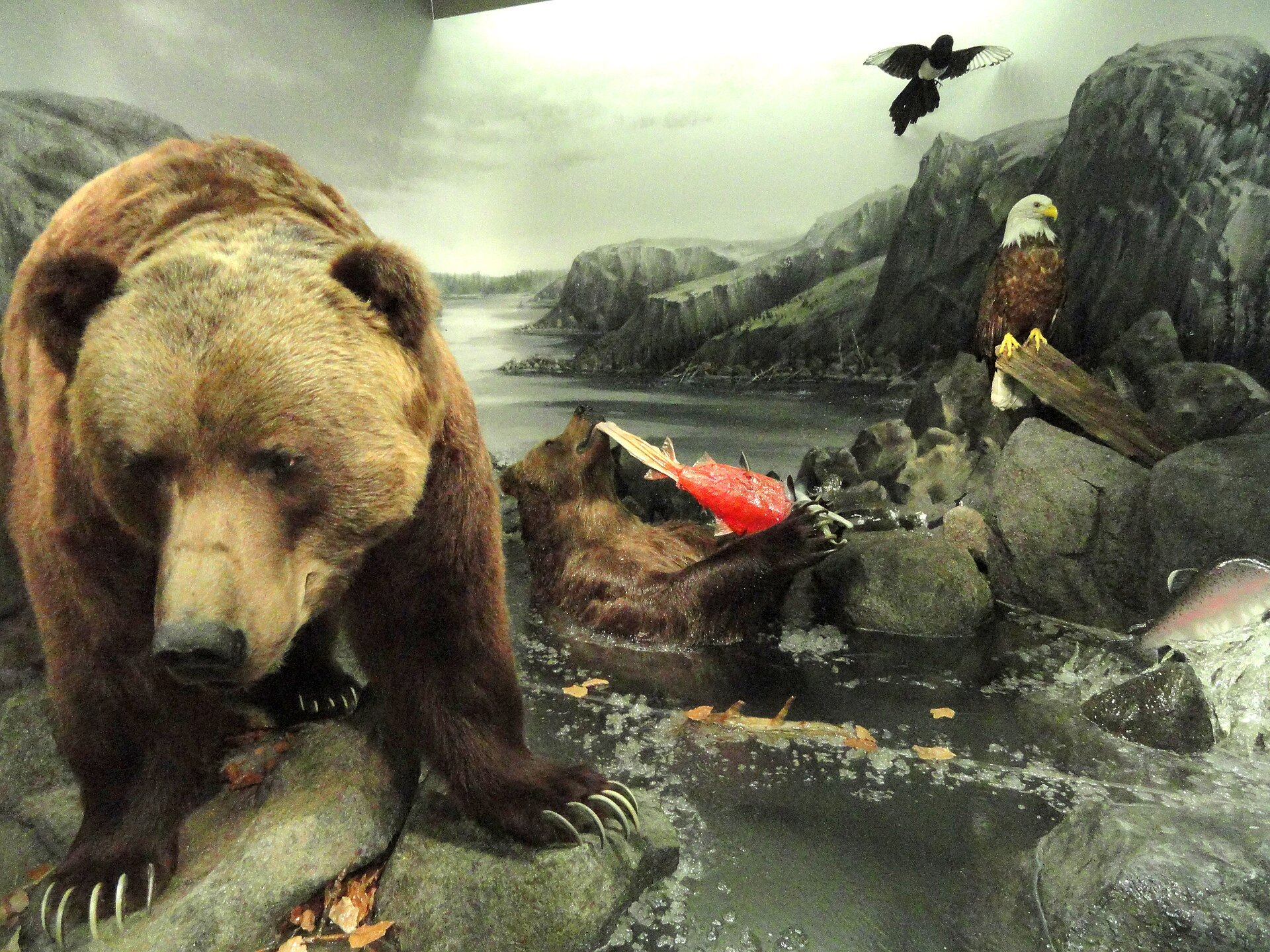
The results were unlike anything seen before. Akeley’s elephants and gorillas have weight, tension and posture. He also insisted that the animals be shown in their habitat, with plants, soil and painted backgrounds made from studies done in the field. His work for the Field Museum in Chicago and the American Museum of Natural History in New York set the standard, and the hall of African mammals at the American Museum, opened in 1936 and named for him, remains the high point of the diorama tradition. Akeley died in 1926 in the Congo, on the expedition that was collecting the gorillas for that hall, and was buried on the mountain where he had studied them.
It is worth pausing on the fact that Akeley, who shot and mounted hundreds of animals, spent his last years campaigning for the creation of what became Africa’s first national park, to protect the mountain gorillas he had come to admire. The best taxidermists have often been the most devoted naturalists.
The diorama era and its decline
Between the 1920s and the 1950s, the great American museums built halls of dioramas that are still among the most visited displays in the world. Each scene involved a taxidermist, a background painter, a botanist making artificial foliage leaf by leaf, and a lighting designer, working for months on a single window. The animals were collected by expedition, with permits, for the explicit purpose of scientific and public education.
That model faded after the middle of the century. Wildlife film made habitat scenes available to everyone, conservation law and public sentiment made collecting large mammals difficult to justify, and museums turned to other priorities. Many dioramas were dismantled; the survivors are now treated as historic artifacts and carefully restored.
Sculpture, foam and the freeze-dryer
Commercial taxidermy inherited Akeley’s method and industrialized it. From the 1960s onward, sculptors produced original models of common game animals in dozens of poses, and these were cast in rigid polyurethane foam and sold to studios by catalogue. A taxidermist today buys a form, alters it with a rasp and clay, and fits the tanned skin to it. The difference between a good mount and a poor one now lies in the fit of the skin, the sculpting around the eyes and the finishing, rather than in the shape of the body.
The last major change is freeze-drying. A specimen is posed, frozen, and placed in a vacuum chamber where the ice sublimates directly into vapor over weeks or months, leaving the tissue dried in place. It is used for small animals, reptiles, birds and, increasingly, for pets, since it preserves the actual body rather than only the skin. Freeze-dried pieces are fragile and prone to insect attack, but they can capture expressions that skin-over-form work cannot.
Alongside all of this, a generation of artists has taken taxidermy back into the gallery, using ethically sourced skins to make work that is by turns beautiful and unsettling. Two hundred and eighty years after the arsenical soap, the arrangement of skin is still finding new things to say.
Read next: Canine Taxidermy: What It Involves, What It Cannot Do and Your Options