
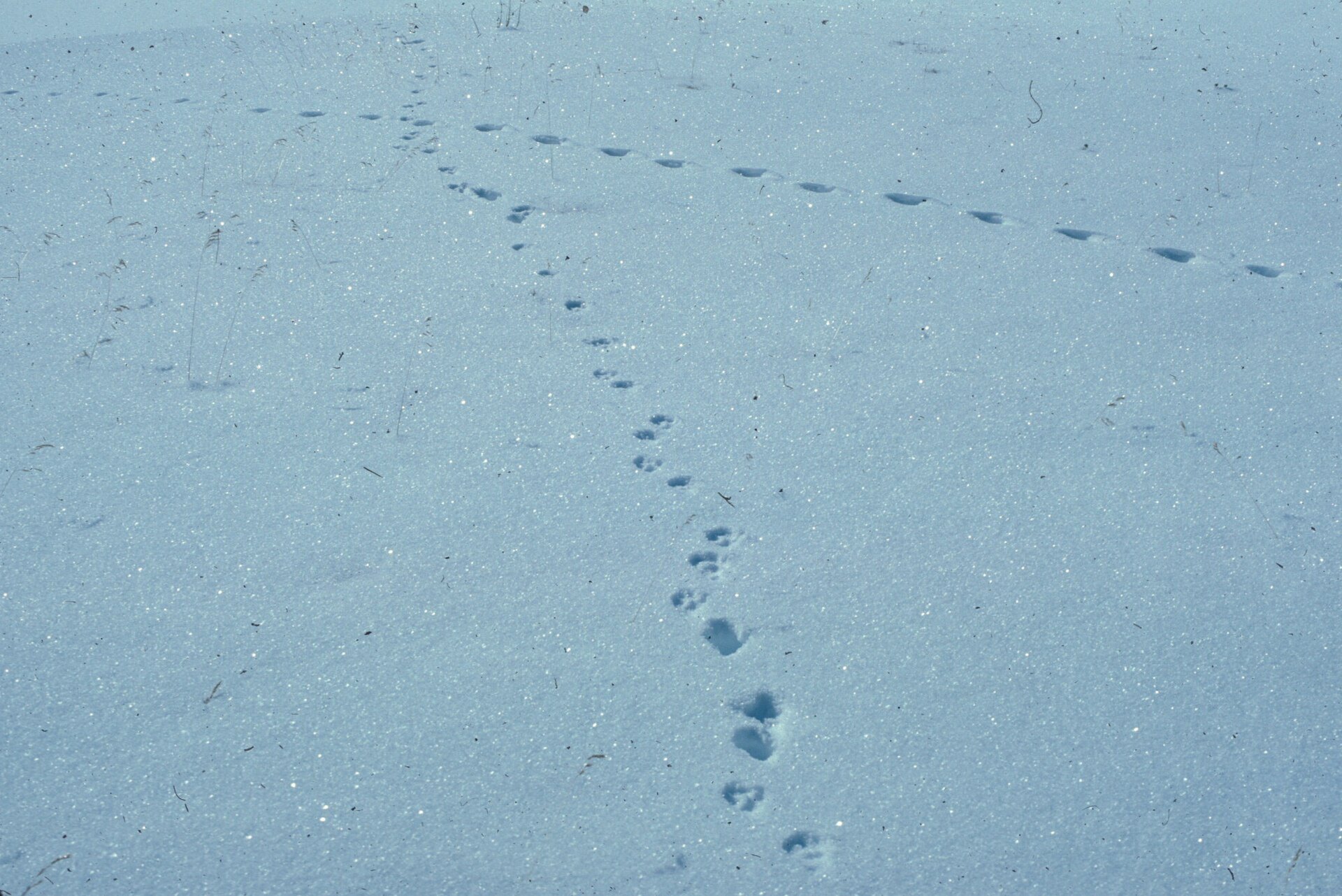
Most of the wildlife in any patch of country is never seen. It moves at night, or when we are not there, and what it leaves behind is the only evidence that it exists at all. Learning to read tracks and sign turns a quiet walk into a crowded one. A muddy creek bank becomes a register of every animal that came to drink, and a dusty road tells you who crossed it and in what mood. None of this requires special gear, only knowing what to look for and being willing to kneel down.
Start with the families, not the species
Beginners try to name the animal from the first track and get frustrated. It is faster to place the track in a family first: the dogs, the cats and the hoofed animals account for most mammal tracks in North America.
Canine tracks, from coyotes, foxes, wolves and domestic dogs, are oval, longer than wide, with four toes and claw marks almost always showing. The heel pad is roughly triangular, and you can draw an X through the space between the toes and the pad without crossing the print. A coyote track is about 2.5 inches long and neat, while a dog track of the same size tends to be splayed and rounder. Feline tracks, from bobcats, mountain lions and house cats, are round, about as wide as long, with four toes and no claw marks because the claws are retracted when walking. The heel pad is large with two lobes at the front and three at the back, and the toes are asymmetrical, with one leading toe like a hand. A bobcat print is about 2 inches across; a mountain lion’s is 3 to 4 inches.
Deer tracks are the third family and the easiest: two teardrop shaped halves, pointed end forward, 2 to 3.5 inches long for a whitetail. Wild hogs also leave a two toed track but the toes are blunter and the dewclaws print wider apart. Raccoons are in a class of their own: five long toes on each foot, with the hind print looking uncannily like a tiny human hand. Opossums show a thumb like toe on the hind foot that sticks out sideways. Once the family is settled, size and location usually give the species.
Gait patterns tell you how the animal was moving
A single track is a photograph; a line of tracks is a film. Every animal has a preferred gait and it shows in the pattern. Deer, cats and dogs mostly walk in a direct register or an overstep, with the hind foot landing on or just ahead of the front track, producing a nearly straight line of prints. Rabbits, squirrels and hares bound, landing with the larger hind feet ahead of and outside the smaller front feet, leaving a distinctive four print cluster. Weasels, otters and mink bound in a 2 by 2 pattern of paired prints. Raccoons and bears amble, with the front foot of one side landing beside the hind foot of the other. The distance between clusters tells you speed. A trotting coyote spaces its tracks about 16 to 18 inches; a running deer can leave 15 to 20 feet between bounds. Follow a trail for fifty yards and you will often see where the animal paused or broke into a run because something startled it, and that something may have been you.
Scat, rubs, beds and the rest of the sign
Tracks are only part of the record. Scat is the most informative sign of all, and the least popular to examine. Deer leave pellets about half an inch long in piles. Rabbits leave round, slightly flattened pellets the size of a pea, fibrous and pale. Coyote scat is rope like, 3 to 5 inches long, tapered at one end and full of hair, bone and seeds, often left in the middle of a trail as a message. Bobcat scat is segmented and blunt ended, and cats often scrape the ground beside it. Raccoon scat is tubular, often contains berries or crayfish shell, and appears in latrines used again and again; it can carry a parasite dangerous to people, so never handle it.
Rubs are the polished patches where a buck deer has scraped bark with its antlers, usually on trees 1 to 3 inches thick; a bear’s rub is a scarred, hairy trunk at chest height. Beds are oval depressions in grass where a deer has lain. Digs are the work of armadillos, skunks and bears looking for grubs. Feathers in a ring mean a hawk kill; feathers with the shafts bitten off mean a fox or a cat. Twigs cut at a clean 45 degree angle are rabbit work, while ragged ends belong to deer, which have no upper front teeth.
Where tracks show best
The substrate makes or breaks a tracking walk. A few places consistently hold good prints:
- Fine mud at the edge of a creek, pond or stock tank, especially after the water drops and leaves a smooth margin.
- Dust on a ranch road or sandy two track, checked early before wind and traffic erase the night’s record.
- Fresh snow, a few hours old, which records everything and even shows the drag of a tail or a belly.
- Sandbars and beaches, where the damp sand just above the waterline holds a clean impression.
- A raked patch of bare soil you prepare yourself along a game trail and check the next day.
Low sun, morning or evening, throws shadows into the print and makes it readable; at noon the same track can vanish. Look at tracks with the sun beyond them.
Making a plaster cast
A cast turns a fleeting print into a permanent reference. You need plaster of Paris, water, a container to mix in, and a strip of cardboard to form a wall. Place the ring around the track, pressing it lightly into the ground. Mix the plaster to the consistency of pancake batter, about two parts plaster to one part water by volume, and pour it in from the side so the flow does not wash out detail, to a depth of at least an inch. Wait 30 to 45 minutes in warm weather, longer if it is cold or damp, until the plaster is hard and cool to the touch. Lift the cast with the soil attached and let it cure for a day before cleaning it gently with an old toothbrush under running water. Label the back with date, place and species. A shelf of casts is the best field guide you will ever own.