
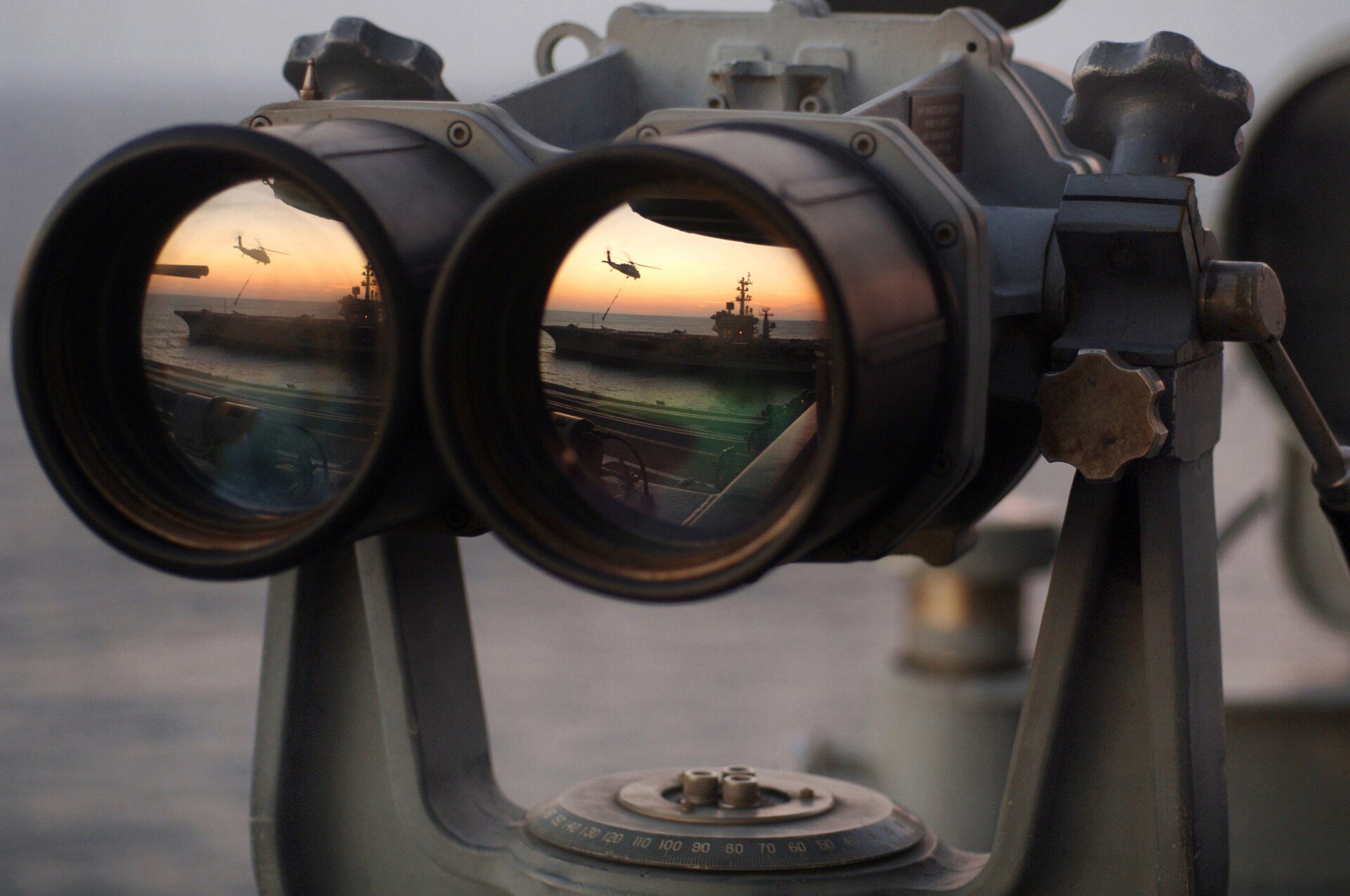
A good pair of binoculars changes how you see the field. Deer that were brown shapes become animals with age and condition, a hawk on a distant snag gets a name, and a slope you would have walked past reveals the ram bedded under the ledge. They are also the piece of optics people most often buy wrong, seduced by big magnification numbers on a box. Here is how we weigh the rest, from exit pupil to the harness that keeps the glass on your chest instead of in the truck.
8×42 versus 10×42: the honest trade
The 42-millimeter roof prism binocular is the standard full-size field glass for a reason: it gathers enough light for dawn and dusk without weighing more than about 24 to 30 ounces. The real decision is 8x or 10x.
At 8x, the image is steadier in the hand, the field of view is wider, typically 7 to 8.5 degrees, which is 370 to 445 feet across at 1,000 yards, and the eye finds and follows a moving animal easily. At 10x you see 25 percent more detail, useful for judging antlers or picking out a bird across a canyon, but the field narrows to roughly 6 to 6.5 degrees, or 315 to 340 feet, and every tremor in your hands is magnified along with the view. Most people can hold 8x steady; many cannot hold 10x well after a climb or in wind. For forest, brush and birding we carry 8x. For open western country, glassing from a fixed spot with elbows braced, 10x earns its keep. A 12x or 15x belongs on a tripod.
Exit pupil, twilight and eye relief
Divide the objective by the magnification and you get the exit pupil, the diameter of the beam of light leaving the eyepiece. An 8×42 delivers 5.25 millimeters, a 10×42 delivers 4.2, and an 8×32 delivers 4. Your own pupil opens to roughly 7 millimeters in full dark when you are young and closer to 5 by your fifties. When the exit pupil is smaller than your pupil, you are losing light you could have used, and this is why an 8×42 looks brighter at last light than a 10×42 of identical quality. In full daylight, when your pupil is at 2 to 3 millimeters, the difference disappears and a compact 8×25 with its 3.1 millimeter exit pupil looks nearly as good.
Eye relief is the distance from the eyepiece lens at which you see the full field. If you wear glasses, you need 15 millimeters or more, and 17 to 19 is comfortable; anything less and the edges of the image go black. Twist-up eyecups let you set the distance; check that they lock at intermediate positions, because the cheap ones flop.
Glass, coatings and the parts you cannot see
Two binoculars with identical numbers can differ enormously, and the difference is glass and coatings. The terms worth knowing: fully multi-coated means every air-to-glass surface carries anti-reflective coatings, and it is the minimum worth buying, since each uncoated surface loses about 4 percent of the light. Phase-corrected roof prisms fix a wave shift inherent to the design and noticeably sharpen the image. Dielectric prism coatings reflect more than 99 percent of light versus about 90 for aluminum. Extra-low dispersion glass reduces the purple and green color fringing you see on a dark antler against bright sky.
Porro prism binoculars, the classic offset shape, deliver better image quality per dollar because the design is simpler, and a 100 USD porro often outperforms a 100 USD roof. They are bulkier, harder to seal, and rarely sold above the budget tier. Roof prisms are compact and rugged and dominate everything above 200 USD. Whatever you buy, insist on a nitrogen or argon purged body with an honest waterproof rating; a fogged internal lens on a wet November morning ends the day.
Close focus matters more than people expect. A glass that focuses down to 6 feet turns into an instrument for butterflies, dragonflies and the details of a mount at the taxidermy bench; many budget binoculars will not focus inside 15 feet.
Price tiers and what the money buys
Under 150 USD you get usable glass with soft edges, some color fringing, and a body that may not survive a fall. Buy a porro here if you can live with the shape. From 150 to 400 USD the roof prism designs become genuinely good: phase-corrected, fully multi-coated, sealed, sharp over most of the field. This is the tier where the majority of serious users should spend, and the improvement over the budget tier is the largest step on the whole ladder. From 400 to 1,000 USD, low-dispersion glass, better coatings and tighter mechanical tolerances give a brighter, more neutral image with an edge that stays sharp, and the focus wheel gets smoother in the cold. Above 1,000 USD, and up to 3,000, the gains are real but incremental: the last few percent of transmission, flat fields, magnesium bodies and lifetime warranties that will actually be honored.
Weight tracks size more than price. Full-size 42 mm glasses run 22 to 30 ounces, mid-size 32 mm about 16 to 22, and compact 25 mm models 9 to 12. If the binocular stays home because it is heavy, the smaller one is the better one.
Harnesses and how to actually carry them
A binocular on a neck strap bounces, swings into rock, and pulls on your spine over a long day, which is why the strap becomes an excuse to leave the glass behind. Two answers exist. An elastic four-point harness, 20 to 40 USD, spreads the weight across the shoulders and holds the binocular flat on the sternum. A chest pack, 50 to 150 USD, encloses the glass in a padded shell with a lid that flips open under your chin, keeping rain, dust and brush off the lenses and making a brief look a one-handed movement. For hunting and any wet or brushy travel we prefer the pack; for birding on a trail the simple harness is faster.
Whichever you choose, add a lens cloth and a rain guard for the eyepieces, and clean the objectives with a soft brush before wiping so grit does not scratch the coatings. Set the diopter once for your eyes, then focus with the wheel alone. A well-chosen 8×42 in the mid tier, worn on the chest and cleaned once a season, will still be sharp in twenty years, and it will show you more of the field than any other single thing you carry.