
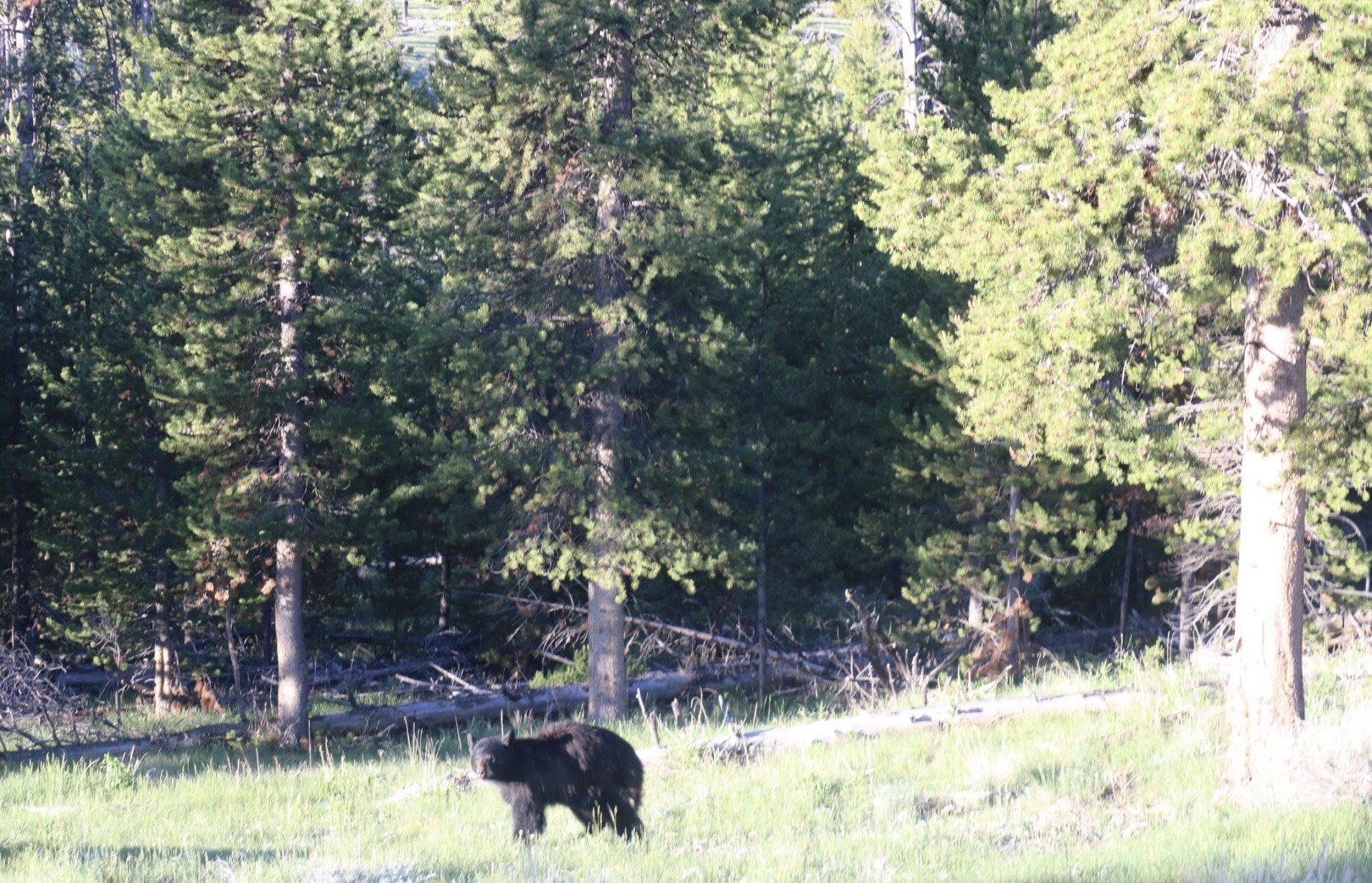
The American black bear is the most common bear in the world, and by a wide margin the one most people will actually meet. It lives within a day’s drive of most of the population of the United States and Canada, it turns up in backyards and campgrounds, and it is far more interested in your cooler than in you. That last fact is the heart of camping safely around bears: nearly every bad encounter begins with food, and nearly every one is preventable.
Where they live and what they weigh
Black bears occupy at least 40 US states, every Canadian province and territory except Prince Edward Island, and the mountains of northern Mexico. The continental population is estimated at 800,000 to 900,000 animals, roughly 15 times the number of grizzly and brown bears. Texas has a small but growing population in the Trans Pecos, mainly in the Chisos and Guadalupe mountains, recolonised from Mexico since the 1980s, with occasional wanderers reaching the western Hill Country.
Despite the name, black bears come in black, brown, cinnamon, blond and, in a coastal corner of British Columbia, white. An adult male typically weighs 200 to 300 pounds, though well fed eastern bears can exceed 500 pounds in autumn. Females run 100 to 200 pounds. Bears stand 2.5 to 3 feet at the shoulder on all fours and 5 to 6 feet upright. They are excellent climbers, strong swimmers and fast over a short distance, with sprints of 30 to 35 miles per hour. No person can outrun, outclimb or outswim a black bear.
A diet that is mostly plants
Black bears are omnivores, but the balance is heavily tilted toward vegetation. Studies across the range put plant matter at 75 to 90 percent of the diet: grasses and sedges in spring, berries in summer, acorns, beechnuts and hickory nuts in autumn. Insects, especially ants and their larvae dug from logs, supply protein. Bears take fawns and elk calves in spring and scavenge carcasses, but active predation on large animals is uncommon. They are opportunists with a sense of smell estimated to be seven times keener than a bloodhound’s, which is why a bag of trail mix inside a tent is not a secret.
Hyperphagia: the autumn feeding frenzy
From late summer into autumn, a black bear enters hyperphagia, a hormonal shift that drives it to eat almost constantly in preparation for winter. A bear in hyperphagia may take in 15,000 to 20,000 calories a day, compared with 5,000 or so in early summer, and can put on 3 to 4 pounds of fat per day. This is the season when bears become bold around campsites, orchards and garbage, and when most conflicts occur. Winter denning follows, usually from November to March or April in the north and for a shorter period, or not at all, in the south. During denning the heart rate drops from 40 or 50 beats per minute to as low as 8, the bear does not eat, drink or eliminate, and a female gives birth in January to two or three cubs weighing under a pound each. A September bear is not the same animal as a June bear.
Camping with bears: the food rules
Safe camping in bear country comes down to one principle: a bear must never get a food reward from a person. A bear that learns that tents and packs contain food becomes a repeat visitor, and repeat visitors are usually killed by wildlife managers. The rules that follow are simple.
- Cook, eat and store food at least 100 yards from where you sleep, and never bring food, toiletries or scented anything into the tent.
- Use a bear resistant canister where required or where trees are scarce, a hard sided container that a bear cannot open; set it on the ground 100 yards from camp, away from cliffs or water where a bear could roll it.
- Where hanging is the rule, hang food at least 10 to 12 feet off the ground and 6 feet out from the trunk.
- Pack out every scrap of garbage and scrape dishwater into a sump hole well away from camp. Burning food waste does not destroy the smell.
- Keep a clean camp in daylight too. A bear that wanders through at noon is the same bear that comes back at midnight.
Many parks and national forests now require approved canisters, and a well used canister has done more to reduce bear conflicts than any other single piece of equipment.
What to do when you meet one
Most encounters end with the bear leaving. Fatal black bear attacks across all of North America average less than one per year, and the majority involve a bear that has decided a person is food, very different from the defensive attacks typical of grizzlies. If you meet a black bear on the trail, stop, speak in a calm firm voice so it knows you are human, and back away slowly while facing it. Do not run or climb a tree. If the bear approaches, make yourself large, shout and throw things. Bear spray is effective at 20 to 30 feet and should be carried where it can be reached in two seconds. If a black bear makes contact, fight back with everything you have, aiming for the face and nose. Playing dead, the advice for a defensive grizzly, is the wrong answer with a black bear. A mother with cubs deserves extra distance but will usually send the cubs up a tree and huff and bluff rather than charge.
Telling a black bear from a grizzly
Where the two overlap, in the northern Rockies, western Canada and Alaska, the correct response differs. Colour is useless, since both species come in black and brown. Look instead at the shape. A grizzly has a pronounced hump of muscle over the shoulders, a dished face with a concave profile, short rounded ears and long, pale front claws of 2 to 4 inches that show clearly in tracks. A black bear has no shoulder hump, a straight face profile from forehead to nose, taller pointed ears and short dark claws of about 1.5 inches. In a grizzly track the claw marks sit well ahead of the toes and the toes form a nearly straight line; a black bear’s toes form a distinct arc. Learning these marks at home is worth an evening, because they are hard to sort out in the moment. Either way, a clean camp is the best bear defence ever invented.