
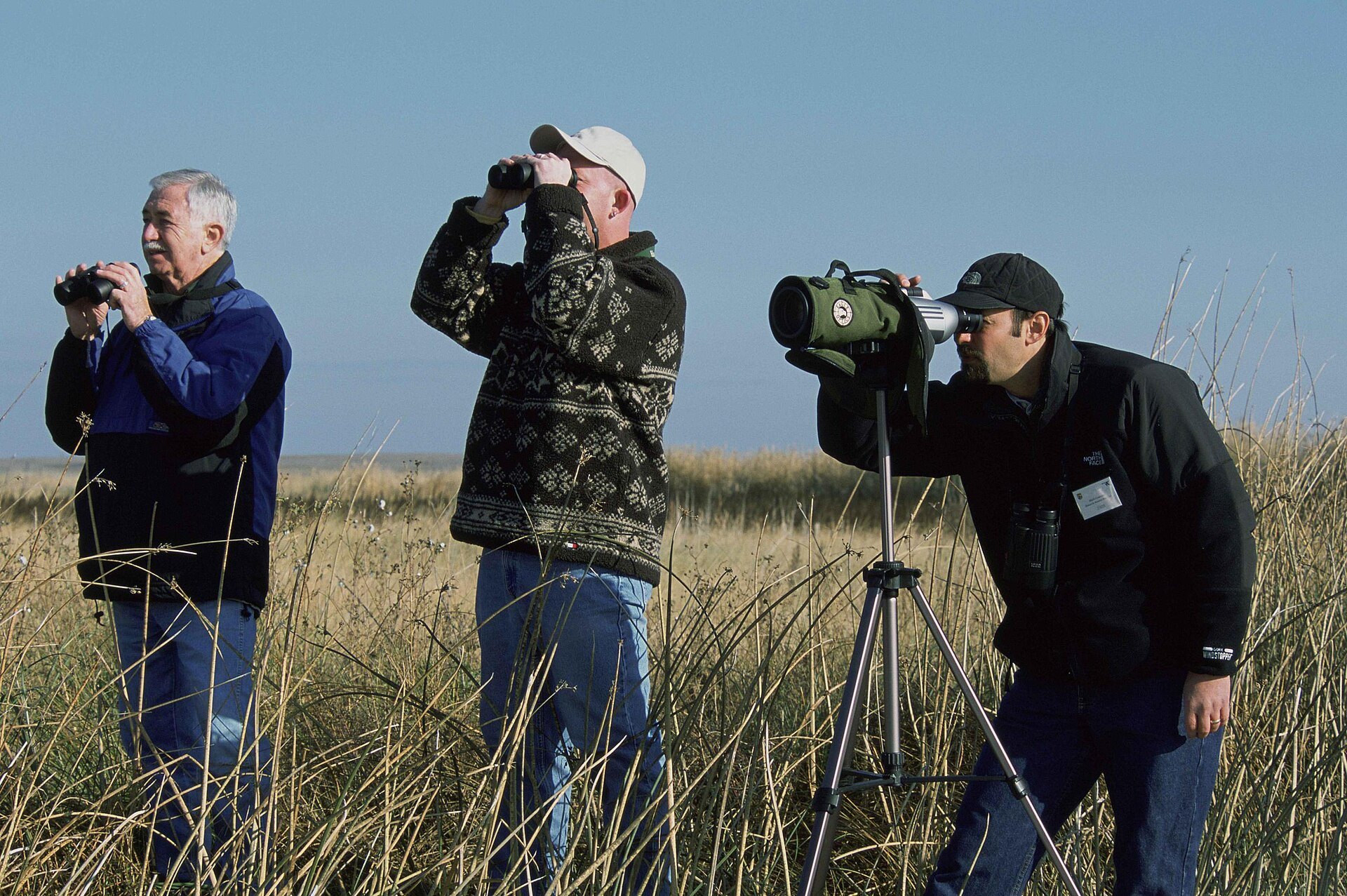
Birding is the cheapest, most portable and most rewarding of all the outdoor pursuits we know. It works in a city park and on a mountain, for ten minutes at the kitchen window and for ten days in a marsh. What it needs is a decent pair of binoculars, a way of looking that most people have never been taught, and a little patience while the first few species settle into memory.
Choosing binoculars: 8×42 or 10×42
Binoculars are described by two numbers: magnification and the diameter of the front lens in millimetres. An 8×42 makes a bird appear eight times closer and gathers light through a 42 millimetre lens; a 10×42 magnifies ten times through the same lens. Both are the standard birding sizes. An 8×42 has a wider field of view, typically 7 to 8.5 degrees or about 380 to 450 feet at 1,000 yards, which makes it easier to find a bird in the glass and to follow one in flight. It is also steadier and brighter, because the exit pupil, the beam of light reaching your eye, is 5.25 millimetres against 4.2 for the 10x. A 10×42 pulls in more detail on distant shorebirds, raptors and waterfowl, at the cost of a narrower view and more shake. For a first pair, especially for woodland and backyard birding, we recommend 8×42. Whatever you buy, check that the eye relief is at least 15 millimetres if you wear glasses, that the close focus is under 8 feet, and that the barrels are waterproof and nitrogen filled so they do not fog.
Learn to use them before you need them. Find the bird with your naked eye, keep your eyes on it, and raise the binoculars without looking down. This one habit is the difference between seeing the bird and seeing an empty branch.
Field marks: what to look at and in what order
Identification rests on field marks, the visible features that separate one species from another. Beginners look at colour first and get lost, because light changes colour and many birds are simply brown. Look instead in this order. Size and shape: is it sparrow sized, robin sized, crow sized, or bigger? Is the bill thin and pointed, short and conical, hooked, or long? Is the tail long or short, notched or rounded? Behaviour: is it climbing a trunk, hopping on the ground, hovering or wagging its tail? Then the pattern: wing bars, an eye ring, a stripe over the eye, a streaked or plain breast, a coloured rump. Only then colour. A bird with a conical bill, a streaked breast and a central breast spot is a song sparrow whatever the light is doing. Describe the bird to yourself in words before you open a guide, and write the words down; the description outlasts the memory.
Silhouettes and the value of a bad view
Most birds you see will be against the sky, backlit, in poor light, or moving. That is why silhouette matters more than colour. A bird on a wire with a long tail and an upright posture is a dove or a kingbird; a hunched shape with a big head is a kestrel; a tiny dot with a stubby tail flitting in the canopy is a kinglet or a gnatcatcher. Soaring birds are told apart by how they hold their wings. A turkey vulture holds its wings in a shallow V and rocks; a red tailed hawk holds them flat and steady; a swallow tailed kite has a deeply forked tail that no other large bird shares. Spend an afternoon on shapes and you will identify a surprising number of birds from a car window. Accept that some birds will get away unnamed; every birder alive has a long list of ones that did.
Seasons change everything
A place does not hold one set of birds; it holds three or four across the year. In Texas the spring migration from March into May brings hundreds of species through, with the Gulf coast recording waves of warblers, tanagers and buntings that have just crossed 500 miles of open water. Summer settles down to the breeders. Autumn migration is longer and more diffuse, from August into November, with hawks passing on north winds and shorebirds lingering on mudflats. Winter brings sparrows, ducks, cranes and geese from the north, and in the Hill Country a good winter day can produce 60 species. The practical lesson is to bird the same spot in every month.
Your first ten species
Start with birds that are common, distinctive and unlikely to be confused, because every later identification is a comparison to something already known. Our suggested ten for the central United States, most of which occur across the continent:
- Northern cardinal: crested, the male an unmistakable red with a black face, the female warm brown with a red bill.
- Blue jay: crested, blue and white with black bars on the wings and tail, loud.
- American robin: upright, grey back, brick red breast, runs and stops on lawns.
- Mourning dove: slim, tan, long pointed tail, whistling wings on take off.
- Northern mockingbird: grey, long tail, white wing patches flashed in flight, sings all night in spring.
- Turkey vulture: large, black, two toned wings held in a V, tiny red head.
- Red tailed hawk: broad wings, pale breast with a belly band, rusty tail on adults, perched on poles along every highway.
- Great blue heron: four feet tall, grey blue, stands motionless at the water’s edge, flies with the neck folded.
- Chickadee: tiny, black cap and bib, acrobatic, the voice that names itself.
- House finch: streaked brown, the male with a red forehead and breast, at every feeder in the country.
Keeping a list, and keeping faith with the birds
A list is the memory of the hobby. Note the date, place, weather, species and, for anything new, a few words about how you knew it. Most people who stick with it pass 100 species in their first year and 300 within a few years of moderate travel. Keep a year list too; starting over each January is a fine excuse to go outside in winter. Lists come with responsibilities. Keep enough distance that the bird does not change its behaviour. Never approach a nest, flush a roosting bird for a better look, or use recorded calls to pull in a rare or nesting species. Stay on the trail, respect private land, and do not share the location of a sensitive nesting bird online. The list belongs to you; the bird does not, and it was here first.