
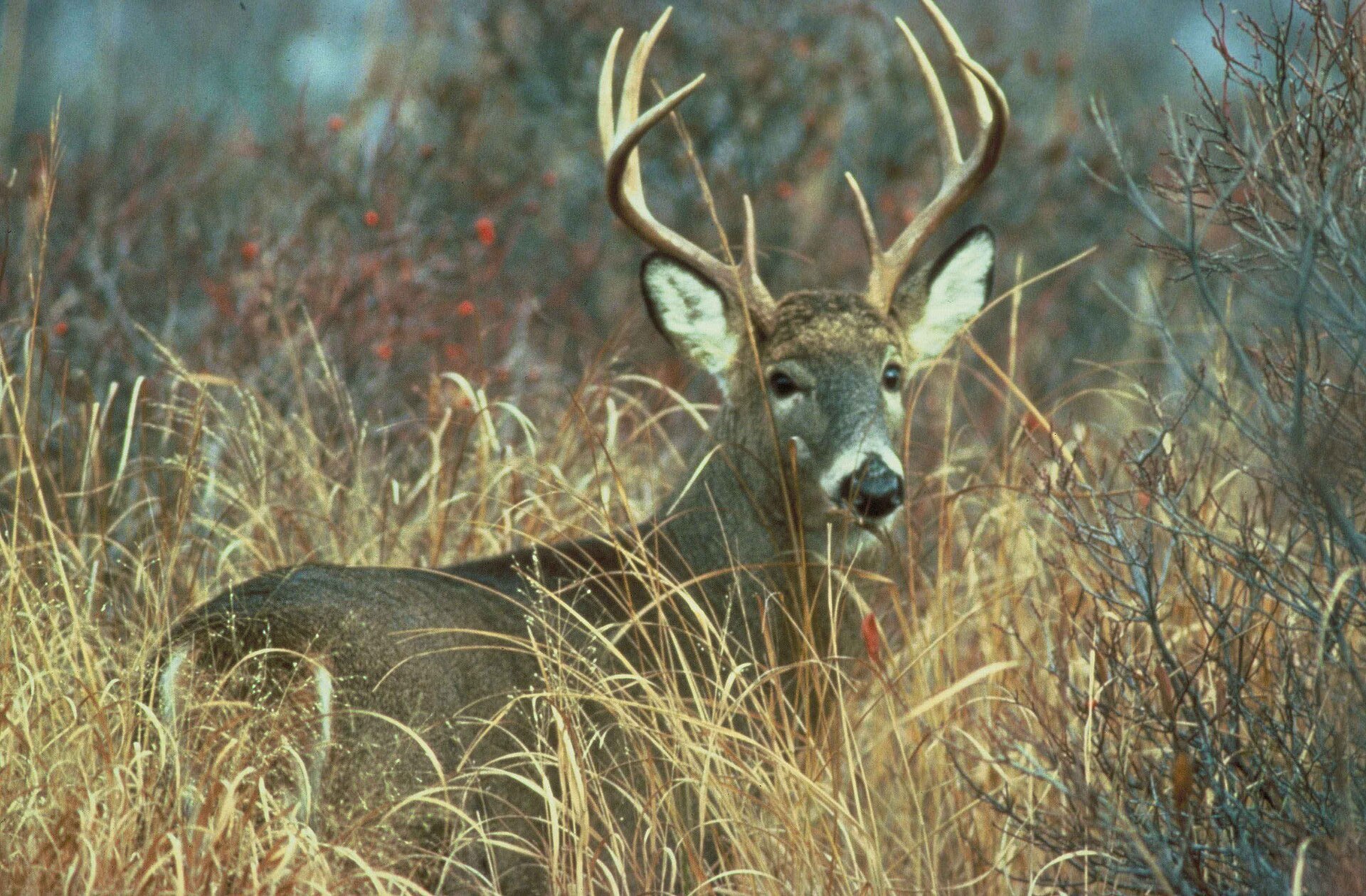
No other big game animal in North America is watched, hunted, photographed and misunderstood as much as the white-tailed deer. It lives in the suburbs and in the deep brush, in Canadian snow and in the thorn scrub of south Texas. Because it is so common, many of us assume we already know it, when most people know what a whitetail looks like and very little about how it lives. This guide covers range and body size, the antler cycle, the rut, the senses and the sign it leaves behind.
Range, size and the many faces of one species
The white-tailed deer occupies the largest range of any deer in the Americas, from the southern edge of the boreal forest in Canada through the entire eastern and central United States, into Mexico, Central America and northern South America. Biologists recognise somewhere between 30 and 40 subspecies, and the differences between them are mostly about size, with northern animals bigger than southern ones. A mature buck in Saskatchewan or Maine can weigh 200 to 300 pounds on the hoof, while the tiny Key deer of Florida may weigh only 55 to 75 pounds. In the Texas Hill Country, where the herd is famously dense, a typical adult buck weighs 100 to 150 pounds live and a doe 80 to 110 pounds. Texas alone holds an estimated 5 million whitetails, roughly a sixth of a continental population near 30 million animals.
A whitetail stands about 32 to 40 inches at the shoulder. The coat is reddish brown in summer and a dull grey brown in winter, changed through two moults each year. The name comes from the underside of the tail, flagged upright when the animal runs, a white signal that other deer can follow through cover.
The antler cycle and the meaning of velvet
Antlers are bone, not horn, grown and dropped every year, which makes them one of the fastest growing tissues in the animal kingdom. The cycle is driven by day length acting on testosterone. In spring, usually April, two pedicles on the buck’s skull begin to push out new growth covered in a soft skin called velvet. Velvet is full of blood vessels and nerves, and it feeds the growing bone at a rate that can exceed a quarter of an inch per day. During this period a buck is careful with his head, because the growing antlers are tender and easily damaged.
By late August or early September the bone has mineralised and the blood supply shuts off. The velvet dries, cracks and is rubbed away on saplings within a day or two, often with the buck eating some of it. Sometime between January and March, as testosterone falls, a layer of cells at the base of the antler weakens and the antlers simply drop, often within hours of each other. Antler size depends on age, nutrition and genetics, in that order. A buck does not grow his best rack until he is five or six years old, and most bucks in heavily hunted areas never get there.
The rut: three weeks that change everything
The rut is the breeding season, and it is the one time of year when a mature buck forgets to be careful. In the northern two thirds of the range it peaks in the first two weeks of November. In south Texas it runs later, into December and even January, and in parts of the deep South it can stretch across several months. Bucks make rubs by scraping bark from small trees with their antlers, both to strengthen the neck and to leave scent from glands on the forehead. They paw scrapes in the ground under an overhanging branch that they lick and chew, and urinate into them. A doe is receptive for only about 24 to 36 hours, and a buck that finds one will stay with her, chase off rivals and travel far outside his usual range. Gestation lasts about 200 days, which places most fawns on the ground in late May and June, when cover and food are at their best; twins are the rule for a well fed doe.
What a deer sees, hears and smells
A whitetail’s defences are built around its nose. The deer’s olfactory system is estimated to be hundreds of times more sensitive than ours, which is why the wind matters more than anything else. The eyes sit on the sides of the head, giving a field of view of roughly 300 degrees, with a narrow binocular zone in front. Deer are dichromatic: they see blues and yellows well and cannot separate reds and oranges from greens, which is why blaze orange is safe for hunters and invisible to the animal. Their eyes are also tuned for low light, with a reflective layer behind the retina that makes them shine in a torch beam. The ears rotate independently and can pinpoint a snapped twig at a surprising distance. The lesson for the observer is simple: stay downwind, move slowly and break up your outline.
Reading whitetail sign
Once you know what to look for, deer country reads like a newspaper. What we check on every walk:
- Tracks: a heart shaped print 2 to 3.5 inches long, pointed end forward. Dewclaw marks usually mean soft ground or a running animal, not automatically a buck.
- Droppings: dark pellets about half an inch long, often in piles of 30 to 60. Clumped, soft droppings point to a diet of green browse or fruit.
- Rubs and scrapes: fresh rubs show bright, wet wood; old ones are grey. A line of rubs on one side of the trees tells you the direction the buck travels.
- Beds: oval depressions in grass or leaves about 3 feet long, often on a ridge or bench where the deer can see below and smell above.
- Trails and browse lines: worn paths between bedding and feeding areas, and a clean line on shrubs about 4 to 5 feet up where every leaf has been eaten.
Why this matters to the taxidermist
Everything above ends up on the workbench. Knowing that a buck’s neck swells during the rut explains why a November cape fits differently than one taken in October. Knowing the antler cycle tells you why a shed found in February is intact and one found in July has been chewed by rodents for the calcium. Understanding the animal in the field is the foundation of representing it honestly, whether the medium is a photograph, a story or a shoulder mount. The whitetail rewards anyone willing to sit still and watch.