
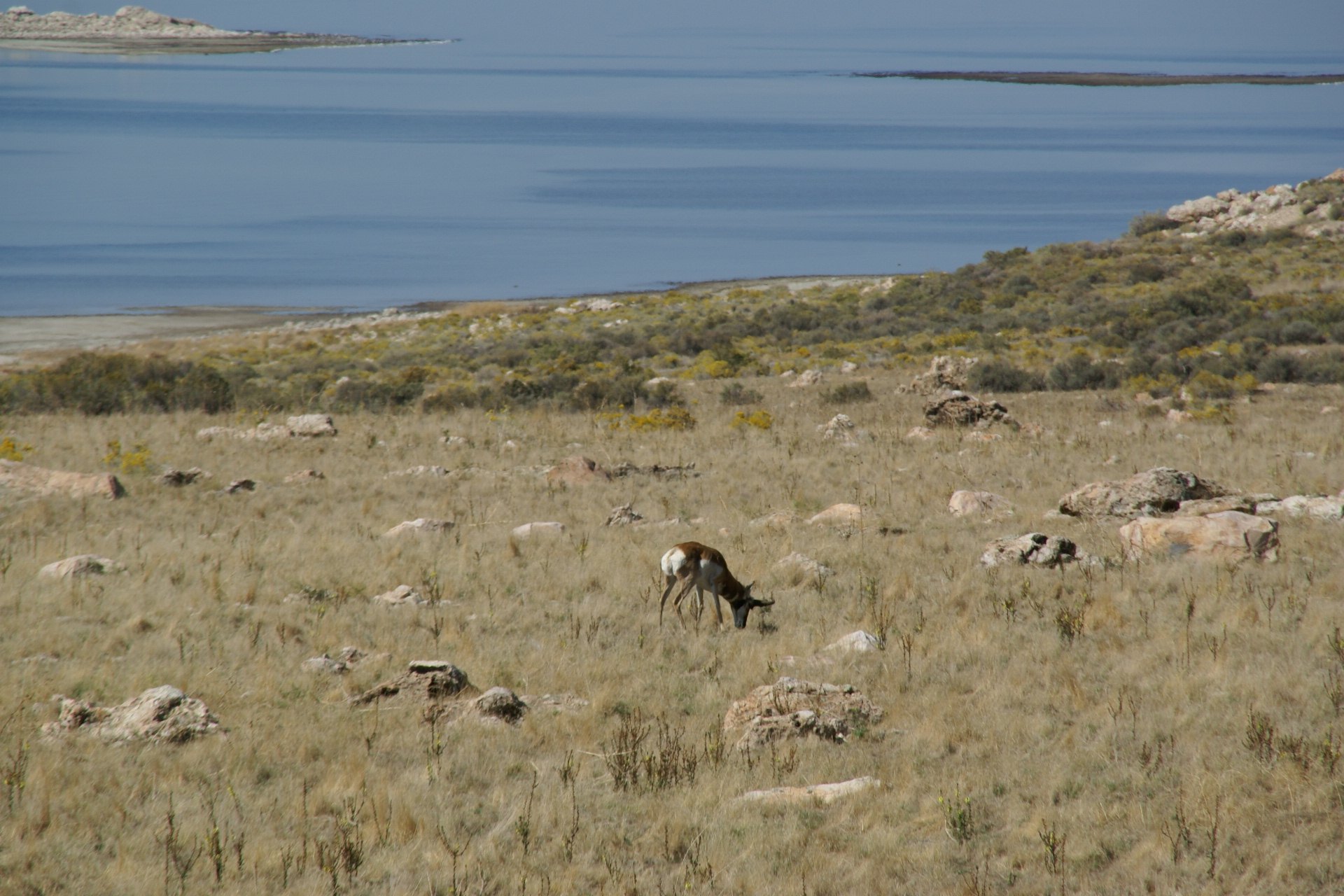
Out on the short grass of the Texas Panhandle or the sagebrush of Wyoming, a pale tan shape sometimes lifts its head, looks at you across a mile of open country, and then leaves at a speed that seems to belong to another continent. That is the pronghorn, often called an antelope though it is not one. It is the last surviving member of a family of its own, the Antilocapridae, that once had a dozen species in North America. It is the fastest land animal in the Western Hemisphere, and it is running from a predator that has been extinct for 10,000 years.
Built for speed nothing alive can match
A pronghorn can reach 55 miles per hour in a sprint and, more impressively, can hold 40 to 45 miles per hour for several miles. The cheetah is faster over a few hundred yards, but it is spent after 20 seconds. The pronghorn is an endurance sprinter with no equal. The engine behind this is an oversized windpipe, lungs and heart, a blood volume larger than expected for a 100 pound animal, and a stride that can cover 20 feet at full pace. Padded hooves absorb the shock of hard ground. No living predator in North America explains this speed; the best explanation is the American cheetah, a cat that hunted the plains until the end of the last ice age. The prey outlived the predator, and it still runs as if the cat were behind it.
Adults weigh 90 to 140 pounds, bucks at the top of that range, and stand about 35 inches at the shoulder. The coat is tan above with a white belly, two white bands across the throat and a large white rump patch. When alarmed, the animal flares the rump hairs into a bright disc visible for miles, a signal that spreads through a herd faster than any call could.
Eyes like binoculars
The pronghorn’s eyes are enormous for its skull, about 1.4 inches across, and they sit far back on the head, giving a field of view of roughly 320 degrees. Their visual acuity is often compared to a pair of 8 power binoculars, a rough comparison rather than a measurement, but it captures the practical reality. A pronghorn can pick out a walking person at three or four miles across open ground. Anyone trying to approach one on foot learns quickly that there is no sneaking up. The animal watches you, decides at what distance it feels safe, and walks or runs to keep that distance.
Horns that are shed every year
The feature that sets the pronghorn apart from every other horned animal is its headgear. Antlers, as on deer, are bone that grows and drops each year. True horns, as on cattle, bighorn sheep and antelope, are a permanent bony core wrapped in a keratin sheath that is never shed. The pronghorn splits the difference in a way nothing else does. It has a permanent bony core, and over that grows a keratin sheath that forks into a forward prong, hence the name. Then, every year, usually in October or November after the breeding season, the sheath loosens and falls off, and a new one grows underneath. Both sexes have horns, though a doe’s are short spikes of an inch or two while a buck’s reach 12 to 16 inches. Shed sheaths are hollow, black and surprisingly light. For a taxidermist, a pronghorn cape presents its own problems, because the hair is hollow and brittle and slips easily if the animal is not cooled fast.
The fence problem
For all its speed, the pronghorn almost never jumps. It evolved on plains with nothing to jump over, and when it meets a fence it will run along it or crawl under the bottom wire rather than clear it, even though it is physically capable of the leap. This makes fences the single biggest obstacle to the species today. Woven wire sheep fencing is a wall. Barbed wire with a low bottom strand catches and kills animals, especially fawns and animals in deep snow. Wildlife agencies and ranchers have settled on a standard: a smooth bottom wire at least 16 to 18 inches off the ground, a top wire no higher than 40 inches, and no woven wire on pronghorn range. Where those modifications have been made, pronghorn move freely again, a rare conservation problem with a cheap and proven solution.
One of the longest migrations on the continent
Some pronghorn are resident, but in the northern part of the range many herds migrate between summer and winter grounds. The best documented is the herd that summers in Grand Teton National Park and winters in the upper Green River basin of Wyoming, a round trip of more than 150 miles that has been used for at least 6,000 years, as archaeological sites along the route confirm. Herds in Montana, Idaho and the Canadian prairies move as far or farther depending on snow depth. These routes squeeze through bottlenecks a few hundred yards wide between highways, subdivisions and fences, and protecting those corridors is now a central goal of pronghorn management. The species numbers around 700,000 to 1,000,000 animals today, recovered from a low of perhaps 13,000 in the early 1900s, with Wyoming alone holding close to half of them.
Where and how to see them
Pronghorn are animals of open country, easy to spot and hard to approach. Places and methods that have worked for us:
- Wyoming, especially the Red Desert and the country around Pinedale and Casper, holds the greatest concentrations anywhere.
- Texas has herds in the Panhandle and the Trans Pecos, with the Marfa plateau being the most reliable place to see them from a public road.
- Grasslands in Montana, South Dakota, Arizona and New Mexico all hold good numbers, and the animals are visible from the highway in many places.
- Stay in the vehicle. A parked truck on a ranch road is something pronghorn see every day; a walking person is not.
- Use a spotting scope or binoculars of at least 8 power and glass the horizon in the first two hours of daylight, when animals are up and moving.
Pronghorn are also curious, and a slowly waved white cloth raised above a rise has been known to draw them closer to see what it is. We do not recommend abusing the trick, but it says something about an animal that has no fear of what it can outrun. Give it distance and it will give you a show.